Post-Anaphylaxis Plan

Action in the Aftermath of an Allergic Reaction

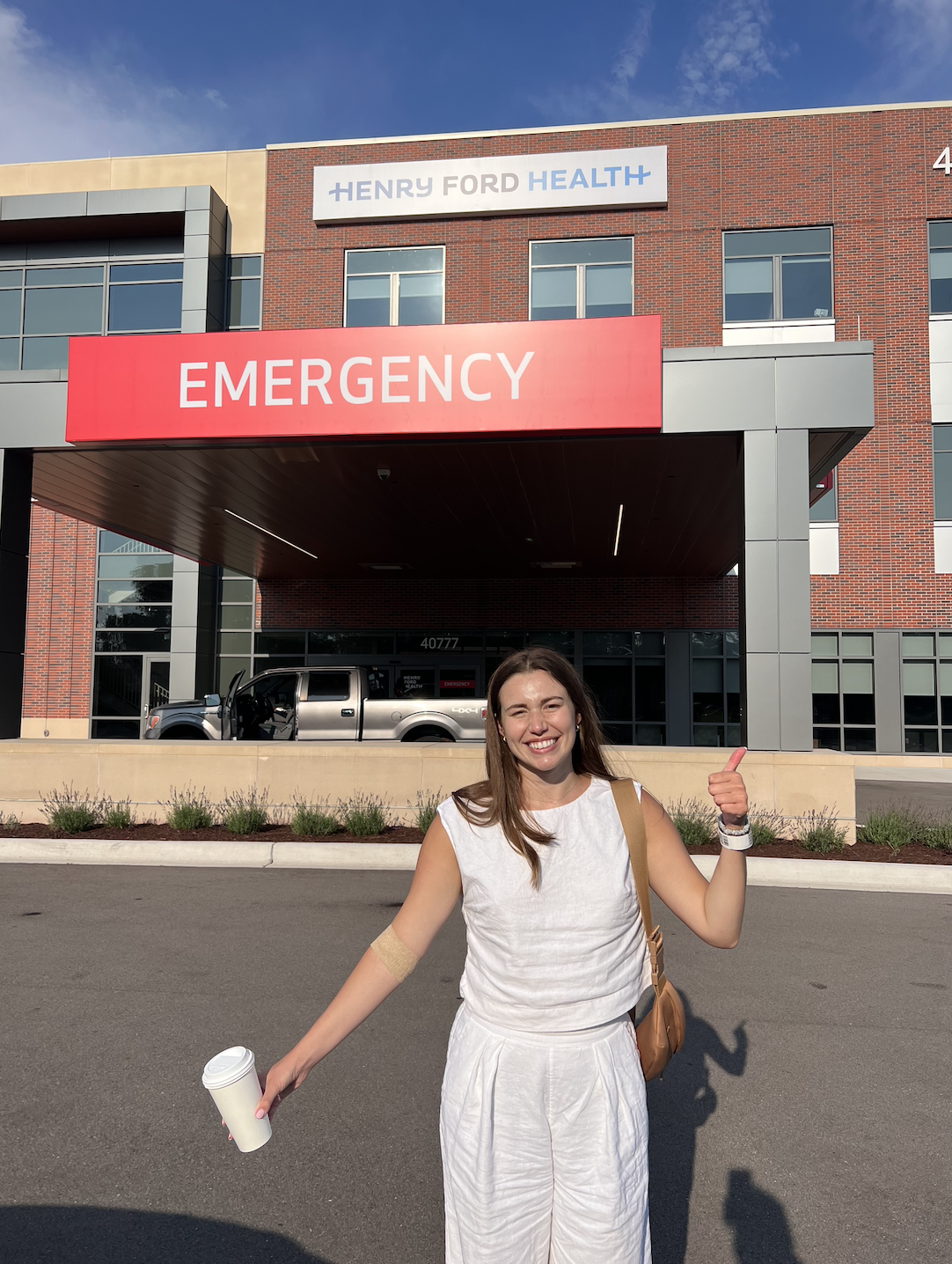
So you beautifully executed your anaphylaxis action plan, your vitals are stable, and you’re ready to be discharged from the ER – But now what?

Walking out of the hospital in a continued daze of brain fog, I wished my emergency action plan hadn’t ended at the emergency room. This recovery journey is just getting started! I needed something concrete to ground my spiraling thoughts, but I didn’t know where to turn.

So, the All things Allergies Post-Anaphylaxis Plan was born.

1. New Epi Prescription

While you’re still in the emergency room, have the attending send a new prescription of auto injectors to your local pharmacy. In the midst of my IV infusions, the last thing I wanted to think about was more needles. But thankfully my mom was two steps ahead with the reminder!

2. Allergist Appointment

Be sure to schedule a follow up appointment with your allergy team to discuss the reaction. If your office is anything like mine, the wait times for an appointment can be lengthy, so be sure to book sooner rather than later.

3. Reestablish Your Sense of Safety

We’re not back to square one, but we’re getting back to basics. For me, this meant home cooked meals and certified allergen-free staples. Cancelling a few new dinner dates with friends and opting for a walk to our tried and true coffee shop instead. Old reliables well inside of my comfort zone to minimize the psychological toll that eating took on my recovering mind and body. Slow and steady will win this race! Pushing myself to get back to “normal” too quickly could have set my healing journey up for failure, so I’m giving myself time to regain the confidence to try new things.

4. Take Extra Care of Your Body

Anaphylactic reactions are systemic, meaning the overactive immune response impacts the entire body. We’re talking inflammation, digestive disruption… And not to mention the physiological consequences of extended doses of steroids! Your body deserves a vacation.

The entire experience understandably did quite a number on me. I arrived home exhausted, dehydrated, and in need of a full-body reset. This meant drinking plenty of fluids, prioritizing quality sleep, resetting my gut health, and sticking to low impact workouts, like yoga and walking. Be sure to listen when your body tells you what it needs to recover.

5. Connect with Mental Health Resources

“One IV of steroids and hours later, I checked out of the emergency room with an “all clear” from the doctor. Although my visible symptoms of nausea and hives were gone, the invisible consequences of my anaphylactic reaction remained untreated. The lasting impact of the chilling event was forever ingrained in my brain.”

The Invisible Consequences of Anaphylaxis, All Things Allergies

Your mental health is just as important as your physical health!

Give yourself some extra grace in the upcoming weeks. Double down on your self care and remember that there is no timeline for healing.

Although we had been meeting monthly, I started booking my therapy appointments weekly following my most recent reaction. We knew that I would benefit from the extra check-ins, and I have been very grateful to have someone to support me as I process through my experience.

Thinking about starting therapy yourself? The Food Allergy Counselor Directory has a list of allergy-informed mental health providers across the United States. Until then, the Food Allergy Counselor has also created a list of post-anaphylaxis reminders for regaining confidence after an allergic reaction. Download the free worksheet here.

6. Spokin Review

Once you’ve had time to process your reaction, consider sharing your story with the food allergy community. Leaving a review on the Spokin Food Allergy App can help warn others about undeclared allergens and potential cross contaminations. Download the free application here, and you might even see a familiar face when you register!

7. Get in Touch with The Food Allergy Community

We’re all here for you, so lean on the food allergy community for support! If All Things Allergies has taught me one thing, it’s that I’m not alone in this – And neither are you. Reach out, ask questions, get advice. It can be incredibly empowering to connect with others who have shared similar experiences, and there is such strength in your vulnerability.


What else would you add to your Post Anaphylaxis Plan?

Epi First + Epi Fast: Lessons Learned from my Third Anaphylactic Reaction

It’s ironic that I have had to spend so much time convincing myself that I’m not having an allergic reaction, that this time I actually needed convincing that I was… The scratchy throat that cried wolf!

All Things Allergies

Thanks to a PTSD diagnosis following a series of life-threatening anaphylactic reactions, I have spent countless meals convincing myself that a sudden lump in my throat is likely a trick of my traumatized brain, rather than swelling from a peanut. The impossible struggle to differentiate the two became so commonplace that I got a chance to practice nearly everyday. In fact, the continued Anxiety or Anaphylaxis? battles have had such a profound impact on me that I have dedicated my entire doctoral dissertation to comparing their physiological and psychological similarities.

So when my throat became scratchy after a few bites of pesto chicken last Saturday, I immediately kicked my coping skills into high gear. Here we go again, I thought.

You could tell my therapist and I had put in some good work together as I started grounding myself in the present moment. Taking deep breaths and sipping on cold water to settle my racing thoughts, I assumed I’d be adding this to the long list of times that I’ve tackled allergy anxiety with some well practiced relaxation tools.

But the feeling didn’t dissipate after a few rounds of box breathing, and waves of nausea began to crash over me. Quite the stubborn panic attack! So I retreated to the bathroom to try to gather myself in private. But those few steps were enough to send my stomach churning, and I began vomiting before I could even get a text message off to my awaiting boyfriend.

When he accompanied me toiletside, I managed to communicate through tearful breaths that while I was having symptoms of an allergic reaction, I was pretty certain it was “just” an escalating panic attack. Let me and my post traumatic distress suffer through this in silence please!

“I think we should take you to the emergency room,” he announced.

“It’s probably just anxiety,” I assured him and myself. “I had coffee jitters this morning and I’ve been on edge ever since.” But as the gravity of his declaration hit me, I had to let myself consider the alternative. Could it actually be the real thing this time? After nearly 20 years of these debates, I had truly lost any sliver of trust in my mind or body to make the distinction.

Recognizing the severity of the situation and my usual stubbornness, my boyfriend hurriedly got my parents on the phone. And even from 500 miles away, they were on the same page – We needed to go to the ER. This Anxiety or Anaphylaxis? dispute was ending in the latter.

Doctor’s Orders

It was these four golden words that snapped me back to reality and got me on board with the plan – Epi First, Epi Fast.

The tagline was coined by Dr. Sublett, Wallace, and Fineman of the American Academy of Allergy, Asthma, and Immunology to demystify the use of auto injectors. The pen can be unnecessarily intimidating, and we often hesitate to escalate our response from an antihistamine to a needle. But this straightforward slogan leaves no room for interpretation or second guesses – Epinephrine auto injectors are a safe, effective, and fast-acting treatment for severe allergic reactions, and doctors agree that they should always be your first line of defense.

So in route to our local emergency room, I self-administered my epinephrine auto injector in the passenger seat of my boyfriend’s car – My gravelly throat softening within minutes.

Upon arrival, I was triaged in the code room and immediately started on a IV of Prednisone, Benadryl, Pepcin, and Zofran. My body continued to reject the food swirling in my stomach, and I required a stronger second dose of anti nausea medications before being moved to a private room for observation.

With time, the emergency room attending recognized the color and smile returning to my face as my vitals stabilized, and we were discharged after about four hours. We picked up my prescription steroids and any food I was willing to snack on, and headed home to continue managing the Invisible Consequences of Anaphylaxis.

Lessons Learned

It’s ironic that I have had to spend so much time convincing myself that I’m not having an allergic reaction, that this time I actually needed convincing that I was. A debrief with my therapist chalked this up to a loss of trust in my own body after decades of it playing tricks on me. I had worked so hard on minimizing worst-case scenario thinking that I didn’t want to listen to my gut when it told me otherwise. The scratchy throat that cried wolf!

So I am grateful for my level-headed support system who immediately jumped to action and got me the care I needed – Even when I couldn’t trust myself, I could trust them.

So lesson learned – Epinephrine first and epinephrine fast. Even in the case of a false alarm, the unwarranted medication is harmless and we’d much rather be safe than sorry. Anaphylaxis symptoms progress quickly, and the consequences can be fatal, so the allergy community has made it abundantly clear what we should do.

I’ll be keeping that tagline in the back of my mind from here on out.

Moving Forward

As I laid stoic in the hospital bed, drowsy from the medications and mentally drained from the events prior, a range of emotions plagued my mind. Despite everything, I was most fixated on what would come of my mental health in the upcoming weeks, considering the aftermath of my previous reactions. While I undoubtedly will need time to recover from this experience, one thing is certainly different this time around.

On the other side of this reaction, I am grateful to have our food allergy community to lean on. When I walked out of the emergency room in 2018, there weren’t resources like Spokin or the Food Allergy Counselor Directory. My friends and family supported my healing, but no one could relate to my individual experience. This time, I walked back into a world alongside The Hivey League, who can assuredly connect to my story – And I imagine it will make all the difference.

Food Allergy Linked to Disordered Eating & Body Image

Happy Food Allergy Awareness Month!

Did you know May is also Mental Health Awareness Month? That is no coincidence in my book.

In celebration of this annual intersection, All Things Allergies is extending beyond our usual trauma-related content into another chapter of the Diagnostic and Statistical Manual of Mental Disorders – Feeding and Eating Disorders.

Research suggests that nearly 9% of the world’s population are affected by eating disorders – A category of illnesses that include anorexia nervosa, binge eating disorder, bulimia, and more. The DSM-V characterizes eating disorders as a, “Persistent disturbance of eating or eating-related behaviors that results in the altered consumption or absorption of food and that significantly impairs physical health or psychosocial functioning.” Eating disorders are among the deadliest of mental health disorders – Second only to drug overdoses. With such high risks of heritability, suicidality, and mortality, mental health professionals and eating disorder specialists around the globe work tirelessly to understand, prevent, and treat these disorders.

Yet, largely absent from disordered eating research is its intersectionality with food allergic diseases, despite the fact that dietary restrictions are strongly associated with increased incidence of eating disorders (Keski-Rahkonen & Mutselin, 2016).

Although not completely understood, Jafri (2021) hypothesizes that the required diet modifications, constant vigilance, and increased attention paid to daily food choices may contribute to the development of disturbed eating behaviors across the food allergy community. The authors stated, “A significant diagnostic feature of these eating disorders is the existence of restricted patterns of eating – Given that the cornerstone of food allergy management is this very type of diet modification, it is difficult to ignore the potential for an increased risk for dietary pathology.”

And ironically enough, it seems that the very thing that keeps us safe from the life-threatening consequences of anaphylaxis is what puts us most at risk for the development of disordered eating patterns. Sigh.

“The maladaptive or disordered dietary behaviors adopted in food allergic cohorts have evolved as a mechanism of avoiding undesirable consequences.”

Jafri, Frykasa, Bingemann, Phipatanakul, Bartnikas, & Protudjer (2021)

Another hallmark feature of eating disorders is body image, or the collection of positive and/or negative thoughts, feelings, and behaviors that you have about your body. Body image is separate from our actual bodily physiology, but can be influenced by personality traits, cultural factors, beauty standards, social media, and medical conditions.

This can include food allergies – A study out of Sweden highlighted how a focus group of adolescents felt something was inherently wrong with their food-allergic bodies, describing themselves as “inadequate, insufficient, and deformed” (Marklund, 2007). Later research gathered similar sentiments from food-allergic adults, who expressed feeling “isolated, embarrassed, and defective” because of their chronic illness (Peniamina, 2014). Aside from the heartbreaking adjectives, researchers discovered a key commonality among the respondents – Rather than viewing their food allergies as an external illness that they had, food allergies were seen as something that they intrinsically were. Their chronic illnesses were internalized, integrated into a stable part of their self identity.

This was the missing link for Jafri (2021) and his team. The authors hypothesized that in combination with the strict dietary modifications required by a food allergy diagnosis, food allergies may be associated – in part – with eating disorder vulnerability as a consequence of disturbed body image and poor self concept. Their predictions are illustrated in the figure below.

Proposed Mechanism for Development of Eating Disorders Mediated by Body Image Disturbance.
(Jafri et al, 2021)

Continued research will be integral for a deeper understanding of the link between food allergies, body image, and eating disorder vulnerability – And we aren’t the only ones advocating for it! Here’s what one research team out of Canada had to say.

“Due to the prevalence of this chronic illness and the evidence that food allergy has a significantly larger impact on quality of life than other chronic illnesses, it is interesting that there does not exist sufficient consideration for the ways the healthcare system or government programs can raise awareness for and address this concern to prevent damaging psychopathologies.

Policy makers must advocate for development of mental health services geared towards individuals with food allergies and consider the possibility that individuals with food allergies who develop patterns of disordered eating are followed in clinics that may escape the scope of practice of eating disorder specialists.”

Jafria, Frykasa, Bingemann, Phipatanakul, Bartnikas, & Protudjer (2021)

I simply could not have said it better myself.


Up next in this All Things Allergies eating disorder series is an investigation into disordered eating patterns as an Invisible Consequence of Anaphylaxis. I’ll share my personal experiences with disordered eating after an allergic reaction, and discuss how the recent acknowledgement of Avoidant Restrictive Food Intake Disorder (AFRID) by the American Psychiatric Association may pertain the food allergy community.

Disclaimer: This post is intended for educational purposes only, and should not be substituted for medical or professional advice. Please contact a licensed medical or mental health professional with further inquires.

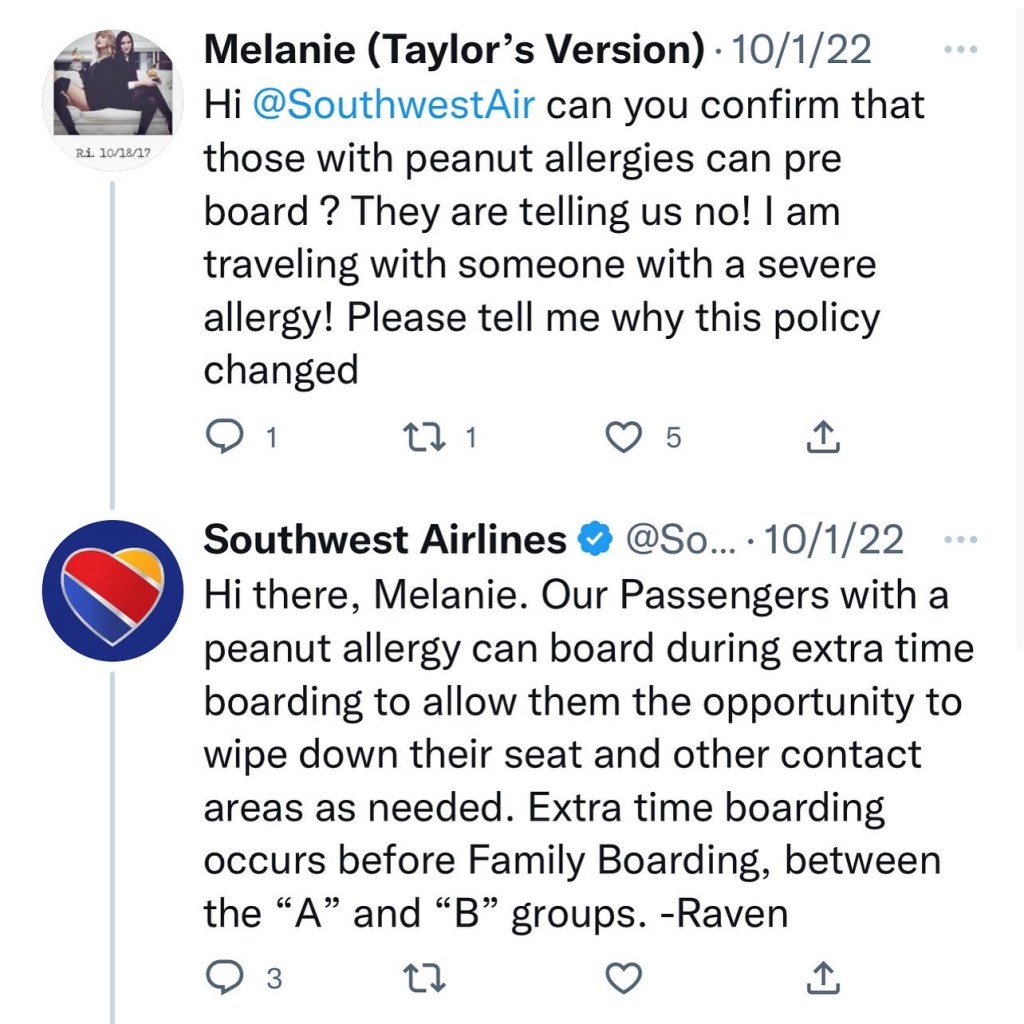
Southwest Airlines Discontinues Their Pre-Boarding Policy for Food Allergies in September – Backpedals in November

In direct violation of the Air Carrier Access Act, as of September 2022, Southwest Airlines no longer offers pre-boarding for peanut allergies.

When Southwest Airlines made the decision to stop in-flight service of peanut products, my family became loyal customers – Religiously recommending the caring and accommodating staff at Southwest to anyone and everyone. Now we are deeply disappointed and disheartened by Southwest’s decision to blatantly disregard and disrespect the life saving needs of the food allergy community.

In a recent tweet, Southwest Airlines stated, “While we offered customers with a peanut allergy the option to pre board in the past, since we no longer serve peanuts onboard, the customers are welcome to board during Extra Time Boarding after the A group and before the B group.”

Yet, Southwest Airline’s own policy states that, “Pre-boarding is available for customers who have a specific seating need to accommodate their disability.” This should include food allergies.

In May 2019, the United States Department of Transportation ruled that airlines, “Must offer pre-boarding to passengers with a disability who self-identify at the gate as needing additional time or assistance to board.” Further, the United States Department of Transportation clarified that severe food allergies are considered a disability under the Air Carrier Access Act (ACAA).

Regardless of the in-flight selection being offered on the airline, the Department of Transportation is clear – Denying pre boarding for passengers with severe food allergies (Not just peanut allergies!) is in direct violation of the Air Carrier Access Act (ACAA).

One step forward, and two steps back. Southwest Airlines – Your decision is not only insensitive, but illegitimate. Do better.


Update: November 2022

After only two months and plenty of backlash from our community, Southwest Airlines has backpedaled on their decision to discontinue pre-boarding acclimations for food allergies. As of November 2022, Southwest Airlines is acting is accordance with the Air Carrier Access Act yet again.

Although our rights under the Americans with Disabilities Act should never have been questioned, I’m still chalking this up as a win. As our community grows, so does our influence. Speak up! Your voice matters.

Anxiety, Or Anaphylaxis?

Exploring the physiological + psychological similarities between anaphylaxis + panic attacks, and how the perceived gap in professional literature may perpetuate somatic trauma responses in the food allergy community.

“We have learned that trauma is not just an event that took place sometime in the past; it is also the imprint left by that experience on mind, brain, and body. This imprint has ongoing consequences for how the human organism manages to survive in the present. Trauma results in a fundamental reorganization of the way mind and brain manage perceptions. It changes not only how we think and what we think about, but also our very capacity to think.” 

The Body Keeps The Score, Bessel van Der Kolk

Introduction

In April of 2021, I openly shared my personal battle with mental health in a blog post titled, Invisible Consequences of Anaphylaxis. Honoring my mission to normalize mental illness in the food allergy community, I am leaning into the academia in order to illuminate a perceived gap in psychological literature + research.

As a licensed mental health counselor + clinical psychology doctoral student, I apologize in advance for any scientific jargon throughout this read. But let me geek out for a bit! Understanding the physiological mechanisms behind my somatic trauma responses brought an important sense of awareness + acceptance to my own personal mental health concerns – An understanding that I hope to be able to share with you, too.

Fight or Flight Response

Before we get ahead of ourselves – Let’s get down to basics.

Many of you have likely heard of our body’s natural defense system. The Fight or Flight Response is our body’s innate acute stress response activated by the sympathetic nervous system. When we find ourselves in physical or emotional danger, research suggests that our body has four options…

  • Fight = Imagine being pulled into a strangers car. Just like every defense class has preached, fighting off your attacker gives you the best chance at survival.
  • Flight = Perhaps a toddler wanders towards a busy street… Your instincts kick into high gear and you bolt to pick them up.
  • Freeze = A burglar enters your home and there’s no exit in sight? You hide quietly in the closet without making a peep.
  • Fawn / Appease = To avoid any further conflict, you comply with the demands of an attacker.

The natural instinct of the human body to defend itself against harm happens without conscious thought. The human body responds instantaneously and automatically to danger by bypassing the prefrontal cortex (The part of our brains that plan, organize, and makes decision). In other words, the Fight or Flight Response is involuntary – We rely on our innate reflexes to protect us.

In order to muster up the strength + stamina needed to survive an emergency situation, the adrenal glands flood the body with hormones, such as epinephrine, norepinephrine, and cortisol. The triggering of our internal alarm system through the release of these chemicals gives the body the necessary energy + alertness to ward off danger. The adrenaline circulating throughout the bloodstream quickly results in physiological changes, including…

  • Increase Heart Rate
  • Quick, Shallow Breathing
  • Digestion Slows / GI Disturbances
  • Nausea
  • Dilated Pupils
  • Tensed Muscles
  • Sweaty Palms
  • Auditory Exclusion / Temporary Hearing Loss
  • Dizziness

If you have experienced these sensations before (Maybe at a Halloween haunted house, or when you couldn’t find your parent at the grocery store) – Good. Your body is working exactly the way it is supposed to.

Panic Attacks

The Diagnostic and Statistical Manual of Mental Disorders defines a panic attack as, “An abrupt surge in intense fear or intense discomfort that reaches a peak within minutes” (APA, 2013, p. 214).

Panic attacks biologically operate through the same Fight or Flight response system, but occur without the presence of actual or threatened danger. Researchers have identified two types of panic attacks – Expected panic attacks that result from a specific trigger (Public speaking, air travel, interviews, etc) and unexpected panic attacks that occur without an obvious trigger (Nocturnal panic attacks).

According to the American Psychiatric Association (2013), at least four of the following symptoms must be identifiable to be considered a panic attack…

  • Palpitations, Pounding Heart, or Accelerated Heart Rate
  • Sweating
  • Trembling or Shaking
  • Sensations of Shortness of Breath or Smothering
  • Feelings of Choking
  • Chest Pain or Discomfort
  • Nausea or Abdominal Distress
  • Feeling Dizzy, Unsteady, Light-Headed, or Faint
  • Chills or Heat Sensations
  • Paresthesias (Numbness or Tingling Sensations)
  • Derealization (Feelings of Unreality) or Depersonalization (Being Detached from Oneself)
  • Fear of Losing Control or “Going Crazy”
  • Fear of Dying

According the Diagnostic and Statistical Manual of Mental Disorders, approximately 11.2% of adults in the United States will experience a panic attack in any given year (APA, 2013, p. 215). Studying that subset of the population, researchers were able to find predisposing factors that make individuals more likely to experience panic attacks throughout their lives. For example, children with neurotic or anxiety sensitive temperaments are at higher risk for panic attacks later in life (APA, 2013, p. 216).

Panic attacks can be also be a, “Direct physiological consequence of another medical condition,” including cardiopulmonary conditions like asthma (APA, 2013, p. 213). Most notably for the food allergy community, Panic Disorder (F41.0) has often been found to be co-morbid with both asthma and irritable bowel syndrome (APA, 2013, p. 214).

Anaphylaxis

Unfortunately, we are all too familiar with this one.

Anaphylaxis is a, “Severe and potentially life threatening allergic reaction… which can occur within seconds or minutes of exposure to something you are allergic to” (Mayo Clinic, 2021). According to the Cleveland Clinic (2021), the activation of mast cells and basophils during anaphylactic shock releases specific mediators that may eventually result in…

  • Shortness of Breath
  • Difficulty Swallowing
  • Swelling
  • Chest Tightness
  • Hives / Rash
  • Wheezing
  • Clammy Skin
  • Increased Heart Rate
  • Low Blood Pressure
  • Dizziness
  • Nausea
  • Vomiting
  • Diarrhea
  • Feelings of Doom

Sound familiar?

The bolded anaphylactic symptoms above represent the identically described symptoms in the definitions of the fight or flight response + panic attacks from earlier in this post.

The eerily similar physical symptoms that accompany our natural stress response make distinguishing an anaphylactic reaction from a panic attack incredibly challenging – Particularly for the traumatized brain.

Trauma

The American Psychiatric Association (2013) defines a traumatic event as, “Exposure to actual or threatened death, serious injury, or sexual violence” through direct experience of the traumatic event, witnessing the event in person, repeated exposure to adverse details of the event, or learning that the traumatic event has occurred to a loved one (APA, 2013).

Some of the more commonly recongizable examples of traumatic events include physical assault, severe motor vehicle accidents, natural disasters, and exposure to war.

Although seemingly less researched across the psychological landscape, certain medical incidents are also considered traumatic events. Clear as day on page 274 of the the Diagnostic and Statistical Manual of Mental Disorders, the American Psychiatric Association distinctly states, “Medical incidents that qualify as traumatic events include sudden, catastrophic events… [such as] anaphylactic shock” (APA, 2013, p. 274).

*DISCLAIMER: Not every traumatic event (Ex. Anaphylactic shock) results in a diagnosable disorder. Please seek consultation from your doctor or a licensed mental health professional for more information.

The Trauma Response

“Being frightened means that you live in a body that is always on guard.”

The Body Keeps The Score, Bessel van Der Kolk

Although our natural Fight or Flight Response is designed to activate in response to actual danger, a traumatized brain can trigger warning signals even when no such threat is actually present. Because it struggles to differentiate between safe and unsafe situations, the traumatized brain defaults to preparing for battle – A body that has been hurt in the past is continuously on high alert to prevent it from happening again.

Deep within our temporal lobes, a hypersensitive amygdala (The fear center of our brains associated with emotion and memory) inside of a traumatized brain prematurely initiates the acute stress response, regardless of whether or not the body is in actual danger. Remember – the Fight or Flight Response happens automatically + unconsciously by bypassing the prefrontal cortex. The amygdala is not seeking out approval from our conscious awareness that knows we are safe – Instead, the amygdala is part of the traumatized brain that is eager to defend itself.

The body and the brain are no longer in sync; Our external reality is not matching our internal experience – That’s thanks to trauma.

Linked on my Amazon Storefront, The Body Keeps The Score by Bessel van Der Kolk beautifully articulates how the traumatized brain + body live in a constant state of hyperarousal. His novel was a fundamental piece in the acknowledgment and acceptance of my own mental health journey.

Anxiety, or Anaphylaxis?

“Okay, Alyssa. It’s clear you have done your homework. But what does this actually mean for the food allergy community?” I’m glad you asked.

Picture this. You are safely eating a home-cooked meal in the comfort of your own kitchen. Your ingredient labels were triple checked + there is no risk of cross contamination when preparing food in your own pans. Bite by bite of your dinner goes down fine until… Is that a lump in my throat? Now that you say it – my stomach feels a little nauseous, too. It escalates as you become aware of your short, shallow breaths. Your heart pounds as your chest tightens. Sweaty hands search for an auto injector. The sensation of choking on a swelling throat reminds you of the emergency room visit after your first allergic reaction. But these anaphylaxis symptoms – Difficulty breathing, increased heart rate, chest tightness, dizziness, sweating, nausea, vomiting – directly mirror those of anxiety. In your hyper vigilant state, it feels impossible to differentiate. But you are not in anaphylactic shock – You are panicking.

It is common for the general public to confuse panic symptoms with a more severe medical emergency, like heart attacks, asphyxiation, or even being on the brink of death; That is anxiety talking. However, throughout the food allergy community, this issue is exacerbated for those who have previously suffered a traumatic anaphylactic reaction, given the distinct similarities between the trauma + the somatic trauma response. Although our acute stress response is initially unconsciously activated, it is consciously perpetuated by continued anxiety + fear about the sudden distressing physical symptoms.

Because what happens when you panic about panicking? You panic.

Personal Experience

“Being traumatized means continuing to organize your life as if the trauma were still going on – unchanged and immutable – as every new encounter or event is contaminated by the past.”

The Body Keeps The Score, Bessel van Der Kolk

My food-induced panic attacks were initiated after an anaphylactic reaction in June 2014. My traumatized brain + body gathered the troops to fend off non-existing threats at almost every meal. The rapid heart rate, short shallow breaths, clammy skin, and nausea I anxiously sat through at the dinner table was practically indistinguishable from those same sensations I had felt headed to the emergency room with an anaphylactic reaction. Refusing to be vulnerable to another threat, my survival instincts were locked into overdrive. Allergen or not, danger or not, my physical body was perpetually ready to fight.

A mental health provider once powerfully validated the juxtaposition between my debilitating internal experience and my seemingly collected external appearance; Acknowledging the pure exhaustion of living inside of a traumatized body. Family + friends struggled to comprehend my persistent anxiety when there was not a visible reason to sound my internal alarms system. But my disconnected mind and body blindly refused to let its guard down + involuntarily suffered the physical fight or flight sensations on a day to day basis.

Despite it all – there is help. After years of trauma informed cognitive behavioral therapy, prescription antidepressant medication, and continued self care + compassion, redefining my sense of safety has allowed me to better manage panic attacks, fainting spells, and anxious thoughts.

Beyond the scientific review of the physiological + psychological impacts of anaphylaxis in this article, my blog post The Invisible Consequences of Anaphylaxis instead intimately explores my personal mental health recovery journey + continued relationship with food anxiety.

Our Community

Through it all, the All Things Allergies community reminds me that I am not alone. The young girl who grew up suffering from mysterious fits of anxiety now reads comforting message after message of similar stories from her followers.

For years, I endured panic attacks without the vocabulary to label them. For longer, I was blind to the invisible consequences of anaphylaxis that perpetuated my somatic trauma responses. Although an explanation would not have been a cure, the capacity to make sense of my symptoms would have jumpstarted my mental health recovery journey.

So, if I can help normalize + verbalize this experience for just one other allergy kid, then I am very proud to be becoming the very woman that I needed as a little girl.

Future Directions

Despite the American Psychiatric Association’s clear recognition of anaphylactic shock as a traumatic medical event, the intersectionality between food allergies and mental health is lacking the proper diagnostic tools, well funded research efforts, and evidence based intervention protocols to effectively treat patients with co-occuring allergies and mental health disorders. So, when my dissertation chair matching process comes along this fall, I intend to propose this perceived gap in psychological literature as my area of focus throughout my doctoral education. Anxiety, or Anaphylaxis? is just the beginning.

Hey professor, if you are reading this blog post, can it count as extra credit?!


Mental Health Resources

You are not alone. Please see my blog post, The Invisible Consequences of Anaphylaxis, for additional mental health resources, publications, and help lines.

Disclaimer

This post is intended for educational purposes only, and should not be substituted for medical or professional advice. Please contact a licensed medical or mental health professional with further inquires.

References

American Psychological Association (2013). Diagnostic and Statistical Manual of Mental Disorders, Fifth Edition. American Psychiatric Association Publishing: Washington, DC.

Cleveland Clinic (2021). Anaphylaxis. Retrieved from https://my.clevelandclinic.org/health/diseases/8619-anaphylaxis

Mayo Clinic (2021). Anaphylaxis. Retrieved from https://www.mayoclinic.org/diseases-conditions/anaphylaxis/symptoms-causes/syc-20351468

Van Der Kolk, B. (2014). The Body Keeps The Score: Brain, Mind, and Body in the Healing of Trauma. New York, New York: Penguin Books.
It All Started With A Mouse: Wishing Upon A Star at Walt Disney World

“In bad times and in good, I’ve never lost my zest for life.”

– Walt Disney

Do you believe in magic?

After a Disney trip full of three course allergy friendly meals, specially prepared + delivered dishes, and safe desserts after safe desserts… We certainly do!

Orlando’s Walt Disney World earned itself a household of loyal customers over twenty five years ago when the parks first took excellent care of my allergy family. From my very first birthday celebration to my twenty first (Drinking around the world anyone?), we fly south every few years to check out the latest and greatest attractions Walt Disney has to offer, surrounded by their exquisite food scene and unrivaled service!

With excellent ingredient labeling on seasonal Christmas confections, and top eight allergen free menu suggestions easily accessible on their app, our latest four-park, five-night stay was sprinkled with a little extra holiday magic while celebrating the 50th anniversary of the most magical place on earth. Bippity bop on through It All Started With A Mouse for a review of All Things Allergies’ Walt Disney World favorites.

Travel

  • Magical Express: Is anyone else devastated about Disney discontinuing the Magical Express? As goofy as it sounds, the luxury transportation from the Orlando International Airport to our hotel was always a noteworthy beginning to our family trip. Not to mention how our suitcases magically appeared at our bedsides just hours later?! Ugh, Uber could never.
  • Disney’s Beach Club Villas: The Bauder’s are devoted Epcot fans so we try to stay in walking distance from their World Showcase entrance. Aside from their sand bottom pools, Disney’s Beach Club offers an on-site marketplace that resembles a miniature grocery store, carrying everything from grab-and-go snacks and ready-to-eat meals, to cooking essentials and fresh produce. We even spotted Enjoy Life Foods products! The villas also come equipped with a full size kitchen – including stainless steel appliances, fresh cookware, and a dining room – perfect for allergy families who plan to cook their own safe meals.

Table Service

  • Space 220: Blast off into space to experience a meal truly out of this world! Once you receive your Centauri Space Station boarding pass, the intergalactic elevator will rocket your party into a dinner among the stars. Choose from a constellation of favorites like the Big Bang Burrata, Starry Calamari, Galactic Lobster Globe, and the Slow Rotation Short Rib while gazing out into the galaxy!
  • Be Our Guest: All roses, no thorns! This Beauty and the Beast inspired restaurant in Magic Kingdom immerses you in the whimsical world of Princess Belle. With the help of Lumiére and Mrs. Potts, enjoy a three course meal from the Beast’s very own peanut free kitchen, which ends with a taste of the Grey Stuff. And yes, it is delicious! Dining inside the castle is a spectacle for adults and children alike; The royal ballroom, where the two shared their first dance, projects the exact snowflake pattern from the original film onto their back windows. Disney never misses!
  • Le Cellier: The Bauder family plans their entire Disney vacation around our reservation for Canada’s premier steakhouse in Epcot’s World Showcase; Our trip simply feels incomplete without a meal at the candle lit château. The Canadian cabin warms my heart each time the kitchen delivers my specially prepared meal while announcing “peanut allergy.” If you need me, I’ll be dreaming about the cheddar cheese soup + mushroom risotto until our next visit.
  • Liberty Tree Tavern: Another peanut free favorite tucked away in Magic Kingdom’s Liberty Square. The cozy colonial style cottage serves an all-you-care-to-enjoy family style feast complete with roasted turkey breast, mashed potatoes, herb stuffing, and house made macaronic and cheese. This reflection of history is bound to make our founding fathers proud!

Quick Service

  • Woody’s Lunchbox: Howdy partner! Round up your crew and feel like a kid again at Woody’s Lunchbox. Even on a muggy Florida afternoon, I’m never saying no to the three cheese grilled cheese and tomato basil soup. Gluten free + allergy friendly bread is available upon request for wheat, soy, and egg allergies, plus plant based “cheddar” and tater tots can be substituted for milk allergies.
  • Sunshine Seasons: In the World Nature pavilion alongside Soarin’ lies Sunshine Seasons, the café offering fresh produce right from Walt Disney World’s greenhouses. The U.S. Department of Agriculture teamed up with Disney to research organic + sustainable farming practices, and Living with the Land offers you a front row seat into magic. Take the boat ride journey after lunch to see just where your meal came from!
  • Lotus Blossom Café: With a history of peanut, tree nut, and shellfish allergies, we never gave the restaurants at Epcot’s Chinese Pavilion a second glance. But after several successful food challenges, my boyfriend encouraged us to give the Lotus Blossom Café a try. Because the staff immediately and confidently knew they used soybean oil, we split chicken fried rice and egg rolls for an afternoon snack. Additional allergen information is listed on their virtual menu, accessible through Disney Magic Mobile.
  • Flame Tree Barbecue: Let’s be honest… My family has been notoriously disappointed in Animal Kingdom’s food scene. Despite our love for Expedition Everest and The Tree of Life, their lack of appetizing and allergy friendly dining options often put this park on our skip list – Until now! The redesigned Disney World app challenged our preconceived notions with the addition of the mobile food ordering. Instead of wasting time in line, we placed an online order at Flame Tree Barbecue while exploring Avatar’s Pandora. Just twenty minutes later, our baked macaroni + cheese topped with barbecue pulled pork, onion rings, and coleslaw was ready for pickup.

New Attractions

  • Star Wars: Galaxy’s Edge: The Rise of the Renaissance attraction inside the new jaw dropping world of Star Wars was worth every single second we waited in the ninety minute line. Every. single. second. After being taken hostage by the First Order, Rey Skywalker and the resistance teamed up to help us escape the Sith Lord. The elaborate exhibition designed by the Disney Imagineers truly transported us into a galaxy far far away.
  • Remy’s Ratatouille Adventure: Anyone can cook! After following along with the Ratatouille Tik Tok Musical throughout the pandemic (Anyone else?!), Remy’s Ratatouille Adventure simply had to be our first stop. Join the virtual queue for this 4D ride, then stop by the Souvenirs de France shop for your exclusive Ratatouille merch!
  • Disney’s 50th Anniversary Very Merriest After Hours: The secret to not missing a single attraction? After hours at Magic Kingdom! This special ticketed event closes the park early to the general public, but permits party goers to explore the park virtually line free until one in the morning. We walked straight on to Space Mountain, and waited no more than ten minutes for the Seven Dwarfs Mine Ride. The private Cinderella’s Castle holiday fireworks show + fake snow down Main Street USA has us rockin’ around the Christmas tree!

Classic Favorites

  • Tomorrowland PeopleMover: Because the queue is never longer than five to ten minutes, it is clear that the PeopleMover is not getting the love it deserves! Zip around Tomorrowland for a backstage look into Space Mountain, Buzz Lightyear, and the new Guardians of the Galaxy construction. Besides, who can say no to a few minutes off of their feet?
  • Les Halles Boulangerie-Patisserie: Our family has a framed painting of this French bakery proudly hung in our home. That is how obsessed we are. Just steps from Disney’s Boardwalk and Beach Club resort hotels, we stop by on our way in and out of the park for a Jambon Beurre Baguette or Strawberry Fraises.
  • The Festival of the Lion King: Can you feel the love tonight? Step into Animal Kingdom’s Harambe Theater for a live action performance of Disney’s The Lion King. Use the “My Genie Day” feature on the Walt Disney World app to snag your party Lightning Lane passes for this half hour show.
  • Toy Story Mania: To infinity! With the addition of Galaxy’s Edge and Mickey + Minnie’s Runaway Railway, we won’t be spending nearly as much time waiting in line for Toy Story Mania. Ironically, with its crisp cool air conditioning and dazzling decor, this interactive ride was actually one of my favorites to wait for! Despite only dedicating one afternoon to Hollywood Studios, we jumped on this attraction three separate times.

When You Wish Upon A Star

Walt Disney World will always hold a special place in my heart because of the inclusively and security I have continuously felt while vacationing at their parks. We vividly recall the safe brownie sundae dessert that the Liberty Tree Tavern chef specially prepared for us back in 2014, and the teal allergy friendly trick or treating stations at Mickey’s Not-So-Scary Halloween Party in 2018. In Disney World, we don’t feel like an inconvenience; For once, we don’t feel guilty.

The superior food allergy protocols practiced across their properties represent the gold standard of kitchen management. Their attention to detail and willingness to accommodate is widely celebrated across the food allergy community, but simultaneously recognized as a luxury that we are only offered on Disney property. My wish upon a star? That culinary teams across the globe follow Disney’s lead. A girl can dream, right?

But in the famous words of Cinderella’s Fairy Godmother, “Even miracles take a little time.”

New Heights: Flying Safely with Peanut Allergies

Much to my dismay, peanuts have become just as synonymous with flying on commercial airlines as they are with American baseball games – And its a travel nightmare.

According to a recent publication for the Center for Food Allergy and Asthma Research (CFAAR), 98% of respondents reported some level of anxiety about airline travel due to their physician diagnosed food allergy – And I was one of them.

As a twenty-something young professional in The Windy City, I find myself flying solo every few months for destination weddings, college football games, and warm weekend getaways. As an anxious flyer (Okay, anxious person), peanut residue on airplane seatbelts is just salt in the wound. Instead of missing out on bestie’s bachelorette party or family holidays in Disney World, I have created a foolproof plan to keep my travel experiences clean and comfortable.

Choosing your Airline

As of August 2018, Southwest Airlines ceased serving peanuts on all of their commercial flights! Southwest Airlines, with a long history of serving peanuts in connection to their Texas roots, recognized the inherent danger that regularly serving this snack caused the food allergy community. In their announcement, Southwest stated “We’ll miss the peanuts, but, at the end of the day, it’s our Southwest Employees and the Hospitality they deliver that set us apart, far more than peanuts ever could.” This is exactly why I became a loyal customer. But they certainly tested my patience, because in September 2022, Southwest Airlines discontinued their pre-boarding policy for food allergies. However, after only two months and significant backlash from our community, Southwest reversed that decision and have reinstated pre-boarding for food allergies as of November 2022. You can read more about their decision here.

If their inconsistency left a bad taste in your mouth, check out United Airlines or Jet Blue instead. Neither company serves peanut products with their in-flight dining services, but they also offer priority boarding. While Delta Airlines does serve peanuts in-flight, they adhere to a pre-boarding policy and offer a six row buffer zone.

Packing Cleaning Supplies

Ziplocks, ziplocks, ziplocks. When preparing my carry on bag before a flight, I put together a disposable bag of cleaning supplies so I am prepared to pre-board the plane. Inside I include…

  • Nice N’ Clean Wipes : As proud supporter of FARE, Nice N’ Clean wipes advertise as being capable of removing 99% of peanut residue from hard surfaces. When I first found these at my local CVS, I bought every single pack at the store.
  • Disposable Rubber Globes : Disposable rubber gloves add an extra layer of protection when wiping down my seat. You never know what was eaten there right before you!
  • Heavy Duty Trash Bag: I don’t know about you, but I am always trying to guess if the crumbs at my feet are pieces of Goldfish crackers or something more sinister. Because airlines require you to stow your baggage during take off and landing, I place my carryon item in a plastic garbage bag under the seat as an extra precaution.
  • Seat Sitters Disposable Seat Cover : After wiping down my row, I lay a disposable cover over my seat for one last layer of protection. All of the strange looks from fellow passengers is worth the peace of mind – And they assume I am protecting against COVID-19 anyways!
  • Individually Wrapped Trip Wipes : This Detroit based brand makes the perfect cleaning supplies for on-the-go. Their individually wrapped wipes are my preferred manor of hand washing after sanitizing the plane.

Wearing Medical Alert Jewelry

Medical alert jewelry is essential, especially for passengers flying solo. Whether you sport a necklace, bracelet, wallet card, or backpack tag, medial alert jewelry gives first responders a head start in case of an emergency.

If you are looking to splurge, Well Aware offers customizable + engraved bracelets to match any outfit. Have an Apple Watch or Disney Magic Band? MyID sells personalized plastic sleeves that fit right onto your wrist watch. My first pieces came from Lauren’s Hope, who offer pages of endless jewelry designs on their website.

In addition to your medical alert jewelry, be sure to set up your Medical ID card on your smart phone. In settings, you can permitted first responders to access your medical ID from your phone’s lock screen, in case of an emergency. Apple allows you to add your allergies, medications, blood type and emergency contacts in the medical notes.

Advocating for Yourself

I have opened up in other blog posts about my struggle with food allergies + mental health – And airports are no exception. In fact, my contamination anxiety is often most crippling during air travel. Horror stories of anaphylactic reactions and families being removed from flights only adds to my preexisting nerves. But we deserve to feel safe – So that’s where self advocacy comes in.

I pass through security with a mobile ticket on my phone, but once I arrive at my gate, I head to the Southwest desk attendant to print my boarding pass. The “Peanut Dust” distinction I mentioned earlier is unfortunately not visible on the ticket in the Apple Wallet. With a physical copy of my boarding pass, I triple check my pre-boarding eligibility with the staff member who scans our tickets before the boarding process begins.

When boarding the plane solo, I immediately inform the flight attendants about my allergies. But important to note: Southwest Airlines does not make an in-flight announcement about allergies on board. Instead, I personally ask the passengers around me if they are willing to refrain from eating nuts throughout the flight. It sometimes feels awkward to interrupt a stranger trying to stow their bag in the overhead bin, but not one person has ever given me a hard time.

Too often I have suffered in silence when I was afraid to speak up. But The Hivey League is worthy of a reminder that prioritizing our health and safety is never selfish. Your peace of mind outweighs any negativity, ridicule, or judgement from others.

Words of Wisdom

  • Book a morning flight. Even though the early wakeup call might feel impossible, most airlines are sanitized at night, awarding you a much cleaner plane when you board.
  • Avoid eating on your shorter flights. Keeping food out of your mouth is a sure way to minimize the risk of a reaction. But if you find yourself getting hungry on long travel days, be sure to pack your own safe snacks. I have been known to keep an 88 Acres seed + oat bar (or five) in my backpack at all times.
  • Pack multiple auto injectors from several different manufacturing batches. I throw four Epi Pens into my carryon bag alongside my inhaler and a bottle of antihistamines.
  • Listen to an in-flight meditation. Headspace offers a short relaxation video specifically catered towards flying anxiety that I download on Spotify before takeoff.
  • Bring a portable charger in your carryon for planes without outlets. Southwest Airlines have its flaws, but don’t we all?! I have been loving this MagSafe Battery Pack from Apple.

Enjoy Your Trip!

Too anyone who is nervous to take flight with allergies – You are not alone. But we deserve to be on that plane just as much as anyone else. Please do not hesitate to reach out directly with any further questions. comments, or concerns. Until then, sit back, relax, and enjoy your trip!

Exposure Therapy: Conquering Food Challenges After Years of Food Anxiety

Safely Experimenting with Cross Contamination

After receiving my negative skin + blood tests from Chicago Family Allergy and Asthma, I was given the “all clear” to food challenge tree nuts, seafood, and legumes at home for the very first time. Given my undetectable IgE levels, Dr. Katie Tanner felt confident in conducting my taste tests outside of their Lincoln Park office. But the girl with a history of severe anxiety, traumatic stress, and anaphylactic reactions was in no such hurry to suddenly pick up an almond joy on her way home. Yesterday I was avoiding tree nuts like the plague… But today you want me to eat one and just see what happens?!

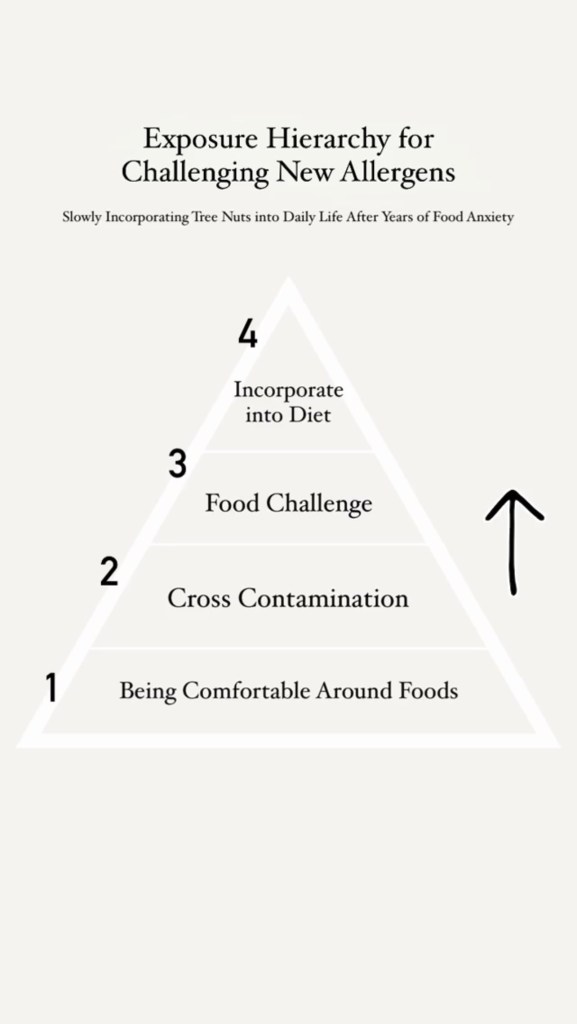
In the food allergy community, we rally around our commonalities – But each of us are the experts of our own respective journeys. So as an exercise in self compassion, I have chosen to take an individualized approach to this process. With more than twenty years of associating tree nuts with danger + disaster, it has been in my best interest to move at pace that feel right for me. So, with consultation from both my allergist and therapist, I created a personalized exposure hierarchy to gradually introduce previously restricted allergens into my everyday life.

Exposure Therapy

Personalized Exposure Hierarchy

According to the American Psychological Association, exposure therapy is a “psychological treatment that was developed to help people confront their fears.” This intervention is often used to treat phobias, post traumatic stress, obsessive compulsive tendencies, and other anxiety related disorders. One variation of exposure therapy is graded exposure – A technique where psychologists help “construct an exposure fear hierarchy, in which feared objects, activities or situations are ranked according to difficulty. They begin with mildly or moderately difficult exposures, then progress to harder ones.” Graded exposure therapies minimize distress by slowly habituating clients towards their desired goal with progressive, but manageable steps.

Following these same principles, we created an exposure hierarchy to manage food anxiety in preparation for my first food challenge. We designed the hierarchy to begin with the least challenging exercise (Being near previous allergens), then move towards my most challenging feat (Incorporating previous allergens into my regular diet). We avoid labeling the inaugural tasks as “easier” because each phase presents with its own expected anxiety. In fact, the purpose of this therapeutic intervention is to gradually minimize that exact experienced arousal by steadily increasing stress tolerance.

(See Mom and Dad?! These psychology degrees are definitely paying off!)

In preparation for my upcoming food challenges, my homework assignment outside of the therapy room has been to actively engage in lower tier exposure activities. Below, I have provided examples for each prong of the exposure latter, moving from least difficult to most difficult.

1. Being Comfortable Around Foods (Least Difficult)

  • Friends + Family Order Previous Allergens at Restaurants
  • Sit by Peers in Class Eating Previous Allergens
  • Purchase Allergens at Store to Bring into Food Challenges

2. Cross Contamination

  • Consume Foods That Poses Cross Contamination Risk to Previous Allergens
    • Starbucks = Almond Milk
    • Sweetgreen = Cashews
    • Do Rite Donuts = Pistachios
    • RPM Seafood = Shellfish
    • Mezza Grill = Chickpeas
    • LINDOR Truffles = “May Contain Tree Nuts”

3. Food Challenge

  • Schedule Food Challenge @ Chicago Family Allergy and Asthma
  • Attend Brief Therapy Check-In During Food Challenge
  • Utilize Meditation, Relaxation, and Breathing Skills to Differentiate Between Anaphylaxis Symptoms and Anxiety Symptoms

4. Incorporate into Diet (Most Difficult)

  • Recommend by Allergist, Consume Previous Allergens on Regular Basis to Maintain Tolerance
  • Purposely Eat Previous Allergens Every 1-2 Weeks
  • Once Proven to be Safe, Build Up Courage to Eat these Foods Away from Home
    • Use Almond Milk in Coffee
    • Hippeas Chickpea Puffs
    • Order Pine Nut Pesto at Dinner

Allergen Hierarchy

Not all allergies are created equally; My food anxiety has seemingly associated more fear with some allergens than others. For example, almonds and hazelnuts feel more intimidating to food challenge than walnuts or pistachios – Despite there being no meaningful difference between the nuts. In fact, the thought of food challenging any tree nut produces significantly more apprehension than legumes or seafood.

Following suit, these allergens fall into a exposure hierarchy of their own. Chickpeas were purposely scheduled for my first challenge to reduce overall uneasiness about trying a previously restricted food in general. Similarly, before my in office food challenge of almonds (most difficult), I will be conducting an at home challenge of walnuts (less difficult). Taking my first bites of almond should hopefully feel less alarming if its not the first nut I have ever eaten.

Next Steps

On Saturday October 9th, I will challenge my first tree nut in the comfort of my childhood home. Just two weeks after testing walnuts, I chosen to host my almond food challenge in the safety of Chicago Family Allergy + Asthma on Friday October 22nd. Stay tuned for updates, because as always, the Hivey League will get a front row seat as I steadily move towards the peak of my exposure hierarchy.

The emotions that I have associated with previous allergens will certainly take time to unlearn, but research in the field of psychology has highlighted the effectiveness of behavioral interventions for extinguishing anxieties similar to mine. Despite close to twenty years of paralyzing food anxiety, I am hopeful – Because being scared means you are about to do something really, really brave.

DISCLAIMER: The content of this post is for educational purposes only, and should not be substituted for medical, psychological, or professional advice. Please consult with your doctor or a licensed mental health professional for more information.

And Then There Was One

And in August of 2021, after twenty four years of embodying the identity of “the allergy kid,” my laundry list of food allergies narrowed itself down to just… one.


Rewind

In preschool, my parents taught my teachers how to properly administer an auto injector in case of emergency. In elementary school, I sat alone at the allergy table across the lunch room from all of my “normal” friends and peers. In middle school, my history with allergies served as my introductory fun fact on the first day of each new class. In high school, I suffered a severe anaphylactic reaction that resulted in a trip to the emergency room and a trauma related disorder diagnosis from my new therapist. In graduate school, I have chosen to specialize in health psychology and aspire to dedicate my dissertation research towards food allergies and mental health. And in August of 2021, after twenty four years of embodying the identity of “the allergy kid,” my laundry list of food allergies narrowed itself down to just… one. 

After my older brother was diagnosed with food allergies in toddlerhood, I was quickly scheduled for an allergist appointment of my own. I returned from the doctors office with paperwork indicating allergies to peanuts, tree nuts, shellfish, fin fish, chicken, eggs, tomatoes, apples, bananas, melon, and a whole collection of environmental triggers. I suffered two anaphylactic reactions by the time I was retested at age 18, where my allergist removed fruit, chicken, and egg from my list, but tacked on chickpeas and other legumes for good measure. Due to my IgE blood test results revealing high reactivity rates, I was prescribed strict avoidance of peanuts, tree nuts, fish, and legumes – Until now.

Here + Now

Weeks before my 24th birthday, I scheduled an appointment at Chicago Family Allergy + Asthma for a standard allergist appointment. Being prone to passing out during blood draws, I had put off being retested for almost five years. Over that half decade, I had graduated college – twice, moved out of state – twice, and began my doctoral degree – thankfully only once. But little did I know, those milestones were not the only major life changes in store for me.

AllergenSkin 2002 (Age 5)IgE 2015 (Age 18)IgE 2021 (Age 24)Skin 2021 (Age 24)
Peanuts4+ > 100.00 H44.70 HNot Tested
HazelnutsNot Tested0.70 H< 0.10
Almond2+< 0.35< 0.10
Pecan2+< 0.35< 0.10
CashewNot Tested< 0.35< 0.10
Pistachio Not Tested< 0.35 < 0.10
Walnut2+ < 0.35< 0..10
Salmon3+< 0.35< 0.10
Tuna3+< 0.35< 0.10
Shrimp1+ < 0.35< 0.10
Timeline of Results | Not All Allergens Included
Skin Test ResultSkin Test InterpretationIgE ResultIgE Interpretation
Negative < 0.10Undetectable
1+ Equivocal Reaction0.10 – 0.35Very Low
2+ Mild Reaction 0.35 – 0.69Low
3+Moderate Reaction0.70 – 3.49Moderate
4+Severe Reaction3.50 – 17.4High
17.5 – 49.9Very High
50 – 100Very High
Interpretation of Results

Words cannot adequately describe my initial reaction when Dr. Katie Tanner called on that August afternoon with the news that I had tested negative to all food allergens, besides peanuts. A range of emotions flooded my mind – Confusion, excitement, guilt, disbelief, hope. The body I grudgingly thought had failed me all those years ago suddenly offered a brand new normal.

Extensive daily precaution was warranted to keep myself safe from these exact allergens. I have avoided shellfish restaurants on seaside vacations, asked friends to substitute oat milk instead of almond milk, requested chefs at Mediterranean restaurants to change their gloves to minimize cross contamination… Now all of the sudden, none of that is necessary? I am hardwired to jump over pistachio shells walking down busy city sidewalks, flinch at the sight of Nutella jars in grocery store aisles, and steer clear of the roasted almond stand at local street fairs. But now you are telling me these foods are safe!?

In the novel Far From The Tree, Andrew Solomon wrote, “Everyone has a defect, and everyone has an identity… and they are often one and the same.” To be clear – I never have considered my allergies to be a defect (Nor are yours), but they have certainly been something that has made me unique. A trait different from those of my friends. Part of my identity, as Solomon wrote. Although I had always wished for a life free from food anxiety, suddenly losing that collection of allergies felt a little like losing some of myself, too. I wore those allergies as a badge of honor, proof how how much I had overcome. Despite being warmly welcomed into this online community, I feared my passion project would be ripped from my hands as All Things Allergies became… All Things Allergy.

But refocusing my mission did not take long. Be the woman you needed as a little girl. Growing out of the majority of my allergies is a unexpected gift that I am still continuing to process, but shortening my laundry list does not change the fact that my life will continue to be shaped by this community. Let’s not forget – I am still anaphylactic to peanuts! One allergy or one hundred allergies, this is part of who I am and who I hope to become. All Things Allergies is not going anywhere.

What’s Next?

Recommended and closely monitored by Dr. Katie Tanner, the next steps of my allergy journey may be the most frightening of them all – food challenges. Because my IgE levels came back undetectable and my skin tests yielded no significant reactions, I have been given the all clear to slowly introduce tree nuts, seafood, and legumes into my diet.

Friends and family are eager to hear my opinion of previously restricted foods, but I am in no such hurry myself. Food anxiety has taken center stage in my allergy journey, and that does not magically dissipate after hearing this news. The All Things Allergies community (Which I will start lovingly referring to as The Hivey League) will be along for the ride as I muster up the courage to take my first bites of foods no longer considered to be dangerous. In an exciting new direction for my blog, All Things Allergies will highlight the intersectionality of mental health x food allergies by candidly exploring my experiences with food challenges, identity development, exposure hierarchies, and continued food anxiety. With consultation from my allergist, guidance from my therapist, and support from loved ones, this “allergy kid” will get her first taste of food freedom.

DISCLAIMER: The content of this post is for educational purposes only, and should not be substituted for medical or professional advice. Please consult with your doctor or a licensed professional for more information.

Invisible Consequences of Anaphylaxis: My Personal Struggle with Mental Health and Food Allergies

The Reaction

During the summer of 2014, as a 17-year-old incoming senior in high school, I took a walk with friends to a local ice cream shop that would unknowingly change the course of my life forever. Half of a brownie flurry later, I was reaching for a bottle of Benadryl in our medicine cabinet as my stomach swirled. The walls seemed to be caving in on me as I laid on the bathroom floor with my parents by my side. Unwilling to change out of my favorite pajamas, we set off for the emergency room as I sat petrified in the backseat.

One IV of steroids and hours later, I checked out of the emergency room with an “all clear” from the doctor. Although my visual symptoms of nausea and hives were gone, the invisible consequences of my anaphylactic reaction remained untreated. The lasting impact of the chilling event was forever ingrained in my brain.

Aftermath

From that June afternoon onward, I struggled to eat. Every meal ended with a silent dash away from the dinner table, sure I was having another reaction. So convinced one night at the local movie theater, I left the film halfway through after breaking down in tears in the bathroom. At varsity swim practice, I became extremely troubled by workouts that limited our breathing. Instead of celebrating my senior season, I was counting down the days until the sport I once loved was over. I washed my hands until they bled, and hyper vigilantly sanitized surfaces that could be a cross contamination risk. Most intrusively, I was repeatedly lightheaded in unfamiliar situations, and began to have a Vasovagal Syncope episode whenever I was emotionally distressed. Similar to when someone becomes faint at the sight of needles, I would experience severe drops in blood pressure and pass out during school, at doctors appointments, and even in the grocery store.

What was happening to me? I did not have the words, nor experience, to describe what I was feeling. The confident, independent young lady I once was suddenly could not even enjoy a home cooked meal or go to a routine appointment alone. Every aspect of my life was severely afflicted in the aftermath of an allergic reaction I was “cleared” from months ago.

Seeking Help

At my mom’s suggestion, and my loss for answers, we decided to seek professional help. Just four months after my reaction, every Saturday morning I began going to therapy. With the help of my new counselor, we processed through the mental and emotional toll of my recent allergic reaction – much of which was dismissed following my “all clear” at the emergency room. She utilized cognitive and behavioral therapy techniques to educate me about the body’s biological response to danger, explore effective coping strategies, and rediscover my sense of safety.

After months of unexplained distressing symptoms and fainting spells, I was finally provided with an answer. An anxious temperament dating back to my childhood had predisposed me to developing a Trauma and Stressor Related Disorder, characterized by reoccurring panic attacks and obsessive compulsive tendencies – All in response to my life threatening allergic reaction.

The Diagnostic and Statistical Manual of Mental Disorders (DSM-IV) is the psychology dictionary that details the symptomatology of all mental illnesses recognized by the American Psychiatric Association. Psychologists and counselors alike utilize this collection of criteria to diagnose and treat their clients. Previously known as “Shell Shock,” Posttraumtic Stress Disorder (PTSD) is often associated with veterans returning from war. While this disorder can certainly affect those in our military, this diagnosis is now applied much more broadly. Posttraumatic Stress Disorder requires a specific “Exposure to actual or threatened death” to meet full diagnostic criteria. Throughout the Posttraumtic Stress Disorder section of the DMS-IV, the American Psychiatric Association has listed hypothetical examples of traumatic events, such as serious vehicle accidents and physical abuse. Medical incidents also qualify as “Exposure to actual or threatened death” in the eyes of American Psychiatric Association – And on page 274, they directly identify anaphylactic shock.

While I certainly characterized my evening in the emergency room as a traumatic event, it was undoubtedly validating to see my experience plainly recognized by the leaders of the field.

*DISCLAIMER: Not every traumatic event (Ex. Anaphylactic shock) results in a diagnosable disorder. Please seek consultation from your doctor or a licensed mental health professional for more information.

A New Normal

Because anaphylaxis symptoms often mirror those of panic attacks (Stay tuned for a full blog post about the Fight or Flight Response), differentiating between a real or imagined threat was nearly impossible. Every shallow breath from panic symptoms felt like a tightening throat from nut allergens; Every racing heartbeat from anxiety felt like the beginning of an allergic reaction.

I attended approximately nine months of weekly therapy sessions tackling these exact concerns. Although the counseling I received in high school empowered me enough to head off to college out of state that next fall, I am by no means cured of my food anxiety. In fact, I continue to struggle to manage stress related to food allergies and beyond daily. While beginning to discern between anxiety and anaphylaxis was a leading treatment goal of my healing process, I am far from mastering it even seven years later. Despite my carefree smile in the photo above, the first sip of that drink had me second guessing my safety just weeks ago.

Trauma lives within the body and leaves a lasting impact that is not healed overnight. I have accepted that adjusting to my body’s natural alarm system will be an ongoing crusade throughout my lifetime.

“We have learned that trauma is not just an event that took place sometime in the past; it is also the imprint left by that experience on mind, brain, and body. This imprint has ongoing consequences for how the human organism manages to survive in the present. Trauma results in a fundamental reorganization of the way mind and brain manage perceptions. It changes not only how we think and what we think about, but also our very capacity to think.”

– Bessel van der Kolk, The Body Keeps The Score: Brain, Mind, and the Body in the Healing of Trauma

Breaking the Stigma

A right of passage for seniors at my high school, the infamous Water Wars league debuted late spring semester. Split into teams of five, the elimination tournament had students dodging water balloons around the community just to win bragging rights. There were a strict set of rules, but anything off of school property was fair game. If you were splashed with water by the opposing team, you were out! Desperate the join in on the fun, I was gutted knowing I would have to watch from the sidelines. My teammates and opponents would surely learn about my Saturday morning routine, and I did not want anyone to know I was seeing a therapist.

Seeking professional help was a secret I kept from close friends and family for a number of years. I had always been the person others turned to for help and reassurance, so admitting my own struggles made me feel weak.

All Things Allergies was founded over a year ago, but I am finally ready to share my story. I have been floored with the number of individuals who have privately reached out to me about food anxiety. A few short years ago, I thought I was alone in this battle. Little did I know, I had a whole online community awaiting to support me. These connections continue to be the inspiration behind my blog – All Things Allergies is the resource I wish I had growing up with food allergies. Back in the height of my food anxiety, I would have been so comforted knowing I was not the only person suffering through this. If I can empower just one person with my vulnerability, every step in my recovery process will have been worth it.

A Particle of Goodness

“And nothing shows more strength than finding a particle of goodness in the worst of situations.”

– Unknown

With tragedy comes triumph. While my allergic reaction derailed much of my senior year and continues to impact my everyday functioning, there were undeniable particles of goodness.

Because of the significant impact that my therapy journey had on the trajectory of my life, in the fall of 2021, I enrolled at The Chicago School of Professional Psychology to pursue my Master of Arts degree in Counseling Psychology. And this summer, after graduating with my limited license, I will be continuing my education at The Chicago School as a doctoral candidate in Clinical Psychology (Dr. Bauder has a nice ring to it, right?!).

The food allergy community deserves experts in the field doing advocacy work and ground breaking research on these topics. As I begin my doctoral education with a focus on the connection between food allergies and mental health, I take solace in knowing my suffering will not go to waste. Instead, my newfound strength can serve countless others in the future. My personal struggles with mental health and allergic reactions not only guided me towards a career in psychology, but towards a calling in life. I found even more than I could have asked for in those fifty minute sessions with my first therapist.

Resources

At the 2019 Food Allergy Conference for Education and Science (FACES) in Chicago, Illinois, I connected with licensed mental health professional, Tamara Hubbard, LCPC. She led a presentation alongside Dr. Jeanna Herzog, PhD., about the emotional impacts of anaphylactic episodes. Tamara Hubbard has created a Food Allergy Counselor Directory that spotlights mental health professionals across the United States who specialize in food allergy treatments. Her website also offers unique insights and resources for food allergy families struggling with a new diagnosis, resilience, or anxiety concerns. I hope to find myself on her directory one day!

Once deciding to steer my future towards a career in psychology, I began volunteering for a non-profit organization called Crisis Text Line. This twenty-four hour crisis hotline is operated completely via text message, perfect for the growing generations less comfortable with verbal communication. Whether you are struggling to calm down from a severe panic attack, need assistance processing through world events, experiencing suicidal thoughts, or are just looking for someone to listen, Crisis Text Line is there for you. Text HOME to 741741 to chat with a certified volunteer crisis counselor today.

Self care is a continuous process in and outside of the therapy room. One of the saving graces that has supplemented my counseling journey is the art of mindfulness meditation. Applications like HeadSpace and Calm offer moments of serenity throughout your busy day. Practicing thought acceptance, deep breathing, and grounding techniques are powerful tools for managing anxiety.

New York Times bestseller The Body Keeps The Score: Brain, Mind and Body in the Healing of Trauma was essential for understanding the physical and emotional mechanisms behind my body’s trauma response post diagnosis. Recommended by my therapist and a favorite in the psychology field, this book helped normalized the years of symptoms I never understood.

The connection between mental health and food allergies is a topic that will continue to be highlighted on All Things Allergies. Check out the ‘Mental Health’ highlight reel on my Instagram feed for research publications, newfound resources, inspiring quotes, and personal stories related to food anxiety.

Ready to start the therapy journey yourself? Psychology Today can help you find licensed, qualified, and experienced mental health professionals in your area at the click of a button.

Conclusion

With the widespread fear and social isolation brought upon by the COVID-19 pandemic, like many others, I have elected to reengage in therapy this past year to ensure a prioritization of my own mental health. There is no shame in asking for support – It shows strength, not weakness!

To anyone out there dealing with something similar – You are not alone. One of the best ways to rid our communities of invalidating stigmas or stereotypes is to foster healthy dialogues and meaningful conversations. Our communication is key, so never hesitate to reach out to me with questions or concerns. Head over to the ‘Contact Me’ page of allthingsallergies.com for the best ways to get in touch.

All the best,

*DISCLAIMER: The content of this post is for educational purposes only, and should not be substituted for medical or professional advice. Please consult with your doctor or a licensed mental health professional for more information.